
Significance
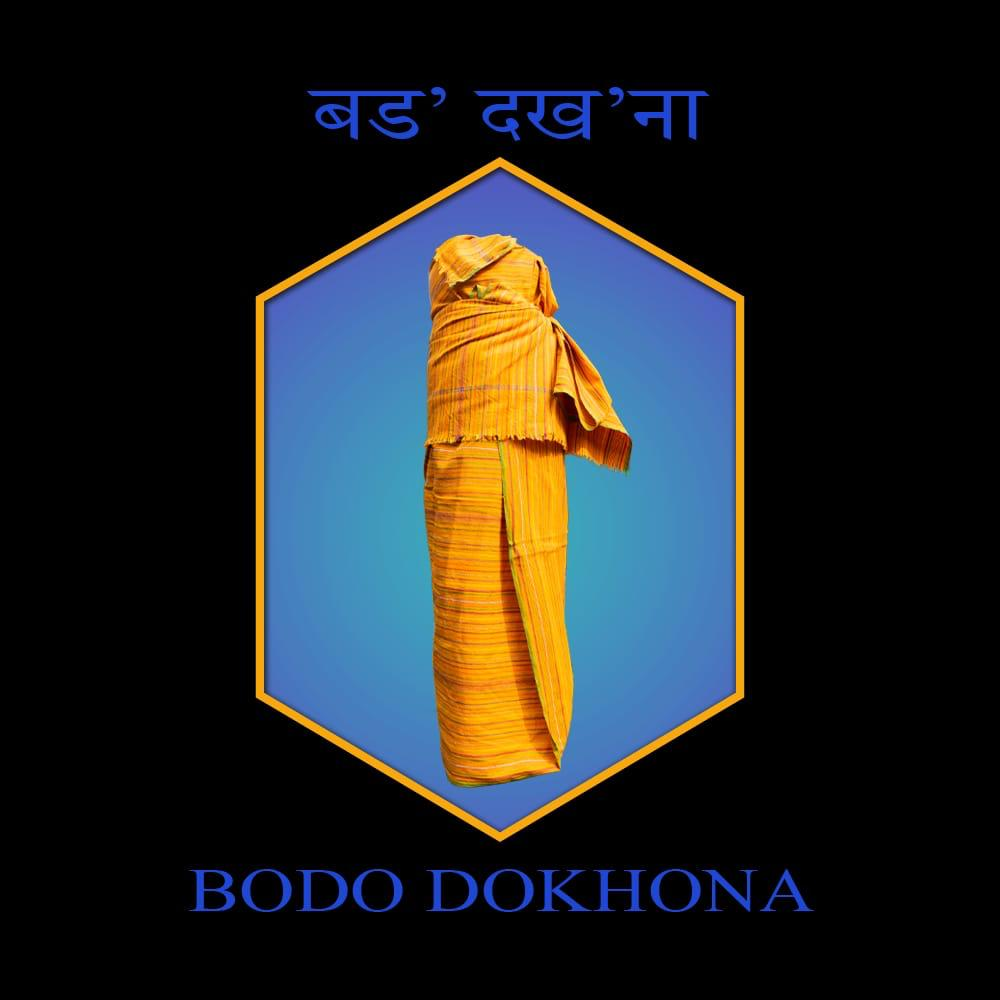
The Dokhona is the main traditional dress of Bodo women — a 3 m by 1.5 m wraparound cloth covering the body from chest to legs, worn in two folds. It is central to festivals, the Bagurumba dance and wedding ceremonies, where the bridal “Dokhona Thaosi” (pure Dokhona) is worn.
History & Cultural Context
The Dokhona is a nature-driven attire whose designs and embroideries are inspired by the weavers’ surroundings — trees, flowers, mountains, birds and other species. Woven in colours such as blue, green, yellow, purple and orange, it is adorned with elaborate Agor designs. When a Bodo girl attains puberty she is welcomed with the traditional Dokhona, and during Bwisagu and seasonal festivals women wear colourful Dokhona paired with a designed Jwmgra.
Process & Techniques
Method of production: Ginning (cotton seeds dried and cleaned with a wooden device); Sizing (material coated with rice powder and maize, boiled with raw rice in a big earthen pot); Spinning (sun-dried material rotated into fine thread and passed through a Grill machine); Winding, Beaming (warp transferred to the weaver’s beam); and Weaving (bobbins coursed into the loom to produce the fabric).
Traditional Knowledge
There are two main types — Matha (plain) Dokhona and Designed Dokhona. Dozens of named Agors are woven, including Parow Megon (pigeon eye), Daorai Mwkhreb (peacock’s wink), Phul Mwbla (bloomed flowers), Maoji Agan (cat’s footprints), Dingkhia Mohor (fern of Dhekia), Bandhuram Agor and Hajw Agor (hills). The “Marhwnai” rice-starch process makes the fabric especially durable.
GI Registration Details
GI Number
GI 605
Application No.
605
Class
Class 24
Filing Date
29 August 2022
Registration Date
March 2024
Registered Applicant
Association of Bodo Traditional Weavers
Facilitated By
Bodo Culture and Heritage Preservation Board (BCHPB)
Geographic Origin
Bodoland Territorial Region (BTR), Assam
Verification Status: VERIFIED
The Trust does not own these GI registrations. GI applicant/registered proprietor information is displayed as documented.